









October 29, 2026
Serving farmers and agricultural drone operators in Tippecanoe County, Montgomery County, and the surrounding west-central Indiana communities.
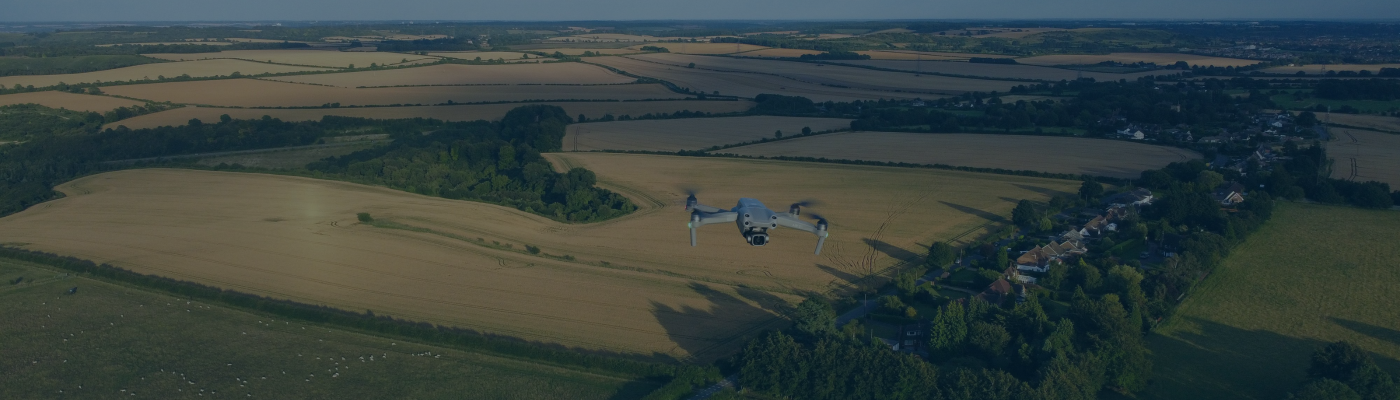
Agricultural drones have moved from novelty to workhorse across Indiana farm country. In the fields around Lafayette, Crawfordsville, and the surrounding counties, spray drones now deliver fungicides, insecticides, and cover-crop seed on acres that used to require a ground rig or a manned airplane. If you operate an ag drone spraying business, that growth is good news — but every job you fly is also a contract, whether you put it in writing or not.
This article explains, in plain language, why a written service agreement between an ag drone operator and the farmer or landowner is one of the most important tools in the business, and what terms that agreement should address under Indiana law. It is written for a general audience and is educational only — it is not legal advice for any specific situation.
What Is an Ag Drone and Ag Drone Spraying?
An agricultural drone — often called a spray drone or, in regulatory language, an unmanned aircraft system (UAS) — is a remotely piloted aircraft that carries a tank and nozzles to apply crop inputs from the air.
Aerial application simply means applying pesticides, fertilizer, or seed from an aircraft rather than from equipment on the ground. When an operator flies a drone over a customer’s field to spray a product for a fee, that operator is running a commercial aerial-application business, with all of the legal responsibilities that come with it.
That distinction matters, because a drone spray operator is not just flying a drone. They are a licensed pesticide applicator handling regulated chemicals over someone else’s property — and often next to a neighbor’s crops, livestock, or water.
Why a Written Service Agreement Matters
A service agreement (also called a service contract) is a written document in which the operator and the customer set out, in advance, what work will be done, for how much, and who bears the risk if something goes wrong. Handshake deals are common in agriculture, but they fail exactly when the stakes are highest: after a misapplication, a drift complaint, an acreage dispute, or an unpaid invoice.
A well-drafted agricultural contract does three things:
- Defines the job so both sides agree on what was promised.
- Allocates risk so a single bad outcome does not sink the business.
- Sets payment terms so the operator actually gets paid.
The rest of this article walks through each of these, with the Indiana rules that shape them.
The Regulatory Backdrop Indiana Operators Should Know
Before getting to contract terms, it helps to understand the legal environment an ag drone operator works in — because your licenses and compliance obligations belong in the customer agreement.
Federal Aviation Rules
Under federal aviation regulations, the person flying a small spray drone generally needs a Part 107 remote pilot certificate with a small UAS rating (or must fly under the direct supervision of someone who holds one). “Part 107” refers to the Federal Aviation Administration (FAA) rulebook for small drones — those weighing less than 55 pounds at takeoff, including everything on board.
Applying crop products from an aircraft for hire is an agricultural aircraft operation, and federal law requires an agricultural aircraft operator certificate to conduct those operations. A drone at or above 55 pounds at takeoff falls outside the small-drone rules and needs separate FAA authorization. Federal rules also prohibit dispensing any registered pesticide from an aircraft in a way that violates the product’s label.
Indiana Pesticide Licensing
Indiana adds its own layer, administered by the Office of Indiana State Chemist (OISC). A person may not apply pesticides on another’s property for hire without a pesticide business license from the state chemist, obtained for each business location, and a business cannot be licensed unless someone in its employ passes a certification examination. An individual who uses pesticides for hire must be a certified applicator, licensed as evidence of their qualifications.
For aerial application specifically, Indiana ties its license directly to federal compliance: the state chemist may issue an aerial-application business license only if the applicant has met all applicable FAA and Indiana Department of Transportation requirements.
An aerial applicant must also submit proof of satisfying aerial-application requirements under state and federal law.
Why This Belongs in Your Service Contract
Two Indiana rules make licensing status contract-relevant.
First, an operator cannot be licensed without a surety bond, liability insurance, or proof of financial responsibility on file to protect people who suffer damage from the operation.
Second — and this is the key point for any operator — Indiana law expressly states that following the pesticide rules does not relieve anyone from liability for damage to another person or their property caused by pesticide use, even when the application complied with the rules. In other words, doing everything by the book does not make you immune from a damage claim.
On top of that, Indiana authorizes civil penalties for letting a pesticide drift off-target and cause harm — up to $500 for a general-use product and up to $1,000 for a restricted-use product. A service agreement is where the operator turns those unavoidable risks into terms both sides understand and accept.
The Four Terms Every Ag Drone Service Agreement Should Cover
1. Confirmation of Acres and the Exact Area to Be Sprayed
The single most common source of routine disputes is not a catastrophe — it is disagreement over what was supposed to be sprayed. This is the scope of work: the precise description of the job.
A good agreement does these things:
- Identifies the fields by name and location
- States the confirmed acreage
- Attaches or references a field map showing boundaries, buffer zones (areas intentionally left unsprayed to protect a fence line, waterway, or neighboring crop), and any areas to be excluded.
- Specify the product to be applied, the target rate, and who supplies and mixes the chemical.
Nailing down acreage protects both sides. Because most ag drone work is priced per acre, an honest disagreement about whether a field was 78 acres or 92 acres becomes a disagreement about the bill. And if the customer later claims the operator missed the back forty or sprayed the wrong field, the written scope and map are the operator’s best evidence of what was actually promised.
Fields and plans change, so the agreement should also include a change-order process — a simple written procedure for adding acres or adjusting the job mid-season, so that verbal add-ons do not turn into later fights. Practitioner guidance for services contracts treats a written statement of work plus a change-order clause as the standard way to control exactly these scope disputes.
Example: A drone operator agrees over the phone to spray the Johnson place. The operator sprays what looks like the main field — 60 acres — and bills accordingly. The farmer expected the adjoining 25-acre parcel included too and refuses to pay until it is done, but by then the crop stage has passed and the application window is gone. A one-page scope attachment with a labeled field map and a stated acreage would have prevented the entire dispute.
2. Liability, Indemnification, and Limitation of Liability
This is where an agreement earns its keep. A few plain-language definitions first:
- Liability means legal responsibility to pay for harm you cause.
- A limitation of liability clause caps how much one party can be required to pay the other if something goes wrong.
- An indemnification clause (sometimes called a hold harmless clause) is a promise by one party to cover certain losses or third-party claims that fall on the other party.
- An exculpatory clause is a clause that releases a party from liability for its own conduct in advance.
Indiana enforces these clauses, but on strict terms — and operators who rely on vague boilerplate are often unpleasantly surprised.
Indiana allows parties to agree that one of them will not be liable for the consequences of its own negligence, and doing so is not against public policy where no statute forbids it. But the clause has to say so specifically. Indiana courts hold that an exculpatory clause “must both specifically and explicitly refer to the negligence of the party seeking release,” and a clause that merely disclaims “any and all” damages without naming negligence is void as to that party’s own negligence.
The same specificity rule applies to indemnification: to shift responsibility for one’s own negligence, the language must be “clear and unequivocal” and reflect the other party’s “knowing and willing” acceptance of that burden.
There are limits on what any clause can do. Indiana courts will not enforce a liability-shifting provision that is buried in fine print, carries no identifying heading, is never explained, and is handed over on a take-it-or-leave-it basis to a party with far weaker bargaining power — such a clause can be struck down as unconscionable (so one-sided and unfair that a court refuses to enforce it). The party trying to enforce the clause bears the burden of showing it was actually explained and knowingly accepted.
General releases also do not reach the most extreme conduct — Indiana does not construe them to cover intentional torts or the more serious forms of misconduct. Consistent with this, practitioner guidance notes that limitation-of-liability clauses are read against the party relying on them, are more likely to be enforced when presented conspicuously (for example, in bold or capitalized text), and cannot be used to escape one’s own fraud, willful injury, or violations of law.
Two practical takeaways for operators:
- A price cap is not automatic protection. Operators sometimes assume a clause limiting damages to the price of the services is bulletproof. It is not. In a recent Indiana crop-damage case, a court declined to enforce a provision capping recovery at the price of the goods or services, leaving the enforceability question for the jury. A cap set unreasonably low compared to the potential harm invites exactly that challenge.
- Indemnity for third-party harm is essential. Aerial application creates real exposure to people who never signed the contract — most obviously a neighbor whose crop is damaged by drift. A well-drafted agreement addresses who is responsible for third-party claims for bodily injury or property damage, which is a standard function of a services indemnity. Because Indiana law says rule-compliant application does not eliminate damage liability, the contract and insurance — not the regulations — are what stand between the operator and a large claim.
Example: An operator sprays a customer’s soybean field on a breezy afternoon. A herbicide-sensitive specialty crop on the adjoining farm is damaged by spray drift — the airborne movement of chemical off the target field. The neighbor sues. If the operator’s agreement with the customer is silent on indemnity and insurance, the operator may absorb the entire loss alone. A clear allocation of responsibility for drift claims, backed by adequate insurance, changes that outcome. Indiana’s measure of damages for a harmed growing crop — the value the mature crop would have had, less saved harvesting and marketing costs — means these claims can be substantial.
3. Price and Payment Terms
Getting the work right means little if the operator does not get paid. A strong agreement states the price (typically per acre, with any minimums or surcharges for difficult fields), when payment is due, and what happens if it is not.
Practitioner guidance for services contracts identifies the standard remedies an operator can build in:
- Interest on late payments
- Reimbursement of reasonable collection costs including attorneys’ fees
- The right to suspend services or terminate the contract if the customer does not pay.
Spelling these out up front is far more effective than trying to negotiate them after an invoice goes unpaid.
The agreement should also address deposits or prepayment for seasonal work, invoicing timing, and how disputed charges are handled — ideally tied back to the confirmed acreage discussed above, so the bill and the scope always match.
Example: An operator finishes a $9,000 fungicide job in July and hears nothing for 90 days. Without a written payment term, there is no agreed due date, no late-payment interest, and no contractual path to recover collection costs. A short payment clause — net-15 terms, interest after 30 days, and recovery of collection costs — turns a slow-pay headache into an enforceable obligation.
4. Other Operational Terms Worth Including
A few additional terms round out a solid ag drone service agreement:
- Weather and rescheduling. Wind, rain, and inversion conditions routinely delay spraying. The agreement should say who decides when it is unsafe or unlawful to fly and how the job gets rescheduled — protecting the operator who correctly refuses to spray in illegal drift conditions.
- Product supply, mixing, and label compliance. State clearly who furnishes the chemical, who is responsible for correct mixing, and that the operator will apply products consistent with the label, as federal law requires.
- Insurance requirements. The agreement should confirm the operator carries appropriate coverage. Services contracts commonly require the provider to maintain commercial general liability and professional liability (errors and omissions) insurance, often naming the customer as an additional insured. For an aerial applicator, this is not optional window dressing — Indiana requires proof of financial responsibility to hold the license in the first place.
- Recordkeeping. Application records (product, rate, date, location, weather) protect the operator if an application is later questioned.
- Governing law and dispute resolution. For operators serving Tippecanoe, Montgomery, and neighboring counties, specifying that Indiana law governs and identifying where disputes will be resolved keeps any disagreement on home turf.
Putting It Together: One Drift Claim, Two Very Different Outcomes
Consider two operators who each fly the same job and each cause the same accidental drift damage to a neighboring field.
The first operator worked on a handshake. There is no written scope, no indemnity allocation, no insurance requirement, and no proof of what was agreed. When the neighbor’s damage claim and the customer’s complaints arrive together, this operator faces them essentially alone — and, as Indiana law makes clear, the fact that the application otherwise followed the pesticide rules does not by itself defeat a damage claim.
The second operator used a written service agreement. The scope and field map show exactly what was sprayed and where the buffer zones were. A specifically worded liability and indemnity provision — the kind Indiana courts will actually enforce because it names negligence in clear terms — allocates responsibility, and a required insurance policy stands behind it.
Same accident, dramatically different exposure. That difference is the entire value proposition of a well-drafted agreement.
Frequently Asked Questions
Yes — two layers of licensing apply.
Federally, you need an FAA Part 107 remote pilot certificate and an agricultural aircraft operator certificate to apply crop products for hire.
Indiana adds a pesticide business license from the Office of Indiana State Chemist (OISC), and at least one person in your operation must pass a certified applicator examination. Indiana also ties its aerial application license to FAA compliance — you must prove you’ve met federal requirements before the state will issue the license.
Under Indiana law, following pesticide application rules does not eliminate your liability for drift damage — even a fully compliant application can result in a damage claim. Indiana courts measure crop damage by the value the mature crop would have had, minus saved harvesting and marketing costs, which means drift claims can be substantial. This is exactly why a written service agreement with clear indemnity provisions and adequate insurance coverage is essential before you fly.
Yes, but only if the limitation language is specific and conspicuous. Indiana courts require that any clause limiting liability for negligence must specifically name negligence — vague “any and all damages” language won’t hold up. Limitation of liability clauses buried in fine print or never explained to the customer can also be struck down as unconscionable. A properly drafted limitation clause, presented clearly and explained to the customer, gives you the best chance of enforcement if something goes wrong.
This is the most common routine dispute in ag drone work — and the easiest to prevent. A written scope of work with a field map, confirmed acreage, and a change-order process for mid-season additions gives you documentary evidence of exactly what was agreed. Without it, a disagreement about whether a field was 78 or 92 acres becomes a he-said/she-said fight with no easy resolution. Most invoice disputes in service businesses come down to scope disagreements that a one-page attachment would have resolved before the job started.
Talk to an Indiana Attorney Before You Fly the Next Season
Ag drone operators in Tippecanoe County, Montgomery County, and across west-central Indiana are building real businesses in a young and fast-changing field. A service agreement drafted for your operation — one that reflects current FAA rules, Indiana pesticide law, and the specific Indiana requirements for liability and indemnity clauses to be enforceable — is one of the most cost-effective investments you can make. A form pulled off the internet often fails exactly the Indiana specificity and conspicuousness tests described above, leaving you exposed when you least expect it.
If you operate an ag drone business, or you are a farmer or landowner hiring one, BB&C can help you put the right agreement in place. Contact us to discuss an ag drone service agreement tailored to your operation and to Indiana law.
Disclaimer: This blog post is provided for general educational purposes only. It is not legal advice, does not create an attorney-client relationship, and should not be relied upon as a substitute for advice from a licensed Indiana attorney about your specific circumstances. Laws and regulations change and their application depends on the particular facts involved.
